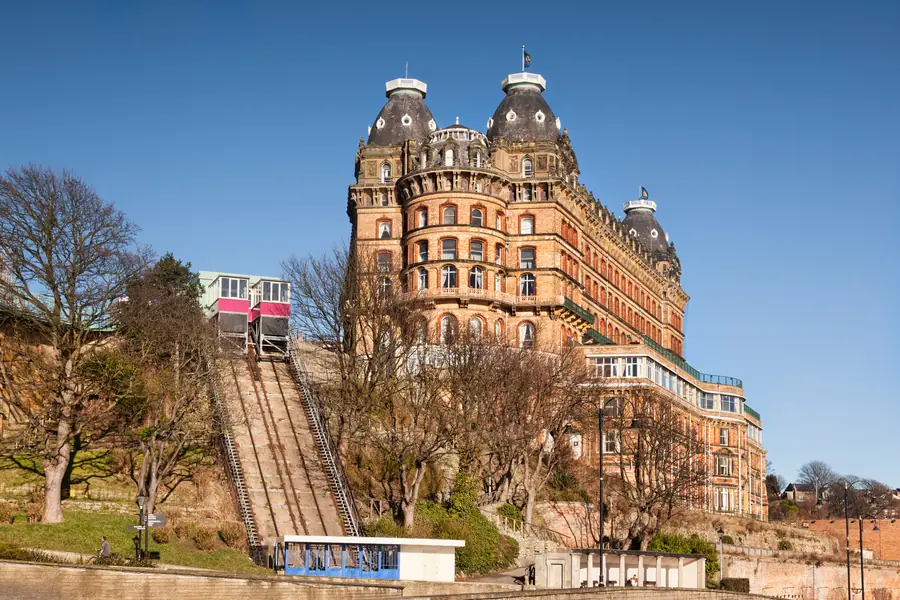
The resort started at the wrong end of the beach, if you arrive from the harbour. South Bay’s northern end is boats, arcades and Luna Park. The southern end is why anyone came: a mineral spring in the cliff, a Victorian spa, a funicular up to the Esplanade, and a chain of gardens cut into the South Cliff. It is quieter, steeper, and a different century from Foreshore Road, which is twenty minutes’ walk north along the same sand.
This is the seafront at the Spa end — not a concert listing, not a hotel brochure. Walk it from the beach, ride the lift if it is running, and give the Italian Gardens the time the rest of the town does not.
In 1626 a woman named Elizabeth Farrow noticed a spring running from the cliff at the southern end of South Bay, staining the rocks. The water was declared medicinal. People came to drink it. By the end of the century Scarborough had a spa, and in the eighteenth century the fashion shifted from the water to the sea. Bathing machines appeared on this beach; the first known English image of one is a Scarborough print. The town became the first English seaside resort.
The wells were buried by a cliff fall in 1737 and dug out again within weeks, which tells you what they were worth to the place. A sequence of spa houses followed. Public consumption of the water ceased in the late 1960s; what remains of the well sits under the complex and is not a visitor attraction. The building is. The gardens are. The idea that you came to Scarborough for your health is the reason the Esplanade looks the way it does.
The complex on the front is Grade II*, owned by North Yorkshire Council, and still a working venue: Grand Hall, Spa Theatre, Ocean Room, Promenade Lounge, Sun Court. Joseph Paxton — the Chatsworth gardener, the Crystal Palace engineer — designed the 1858 buildings, with a double promenade, a colonnade and a prospect tower. A fire destroyed the saloon in September 1876. The Grand Hall that replaced it opened in 1879, with a formal ceremony in 1880. That is the hall you walk into.
By the 1880s music had overtaken the water. The Spa became one of the most popular music-hall venues outside London. The Spa Orchestra still plays a summer season here, the last professional seaside orchestra of its kind. There is a jazz festival in the autumn, theatre, tea dances, conferences. The programme lives on scarboroughspa.co.uk. Do not invent a show from a poster in a guest-house porch.
Britain’s oldest funicular was built to solve a simple problem. The Spa sat at beach level; the hotels sat on the Esplanade, about 200 feet above. In 1873 the Scarborough South Cliff Tramway Company was formed. The lift opened on 6 July 1875: two cars of twenty passengers, a 1-in-1.75 gradient, a track of 87 metres, a penny a ride, 1,400 people the first day.
It was water-balanced at first, then steam, then electric after a 1930s rebuild that also replaced the cars — the ones still on the rails, later modified for access. At its peak in the 1940s it carried more than a million passengers in a season. The council bought it in 1993 and automated it in 1997.
It has been taken out of service before, for rails, for cars, and, in August 2026, after an independent engineering assessment of the ageing infrastructure. North Yorkshire Council posted that closure on the Spa’s own cliff-lift page. Further updates go there. Do not plan a day around a ride until you have checked it is running. Off season it has always been weather- and demand-dependent anyway.
Cut into a fold of the cliff between the Esplanade and the Spa, laid out in 1912 by the same Harry W. Smith who did Peasholm, on land the Corporation bought from George Lord Beeforth. A formal rectangular terrace: lily pond, clipped hedges, urns, a statue of Mercury, pavilions at each end, long views over South Bay framed by the planting.
They sit in a hollow. The wind that scours the Esplanade misses them. The noise of Foreshore Road does not reach. The effect is of a room rather than a park, which is why people who find it call it a hidden gem and why people who do not find it spend the day on the sand.
The original Mercury was lead, given by Alfred Shuttleworth; the figure there now is a resin copy. The terrace itself is largely level. The approaches from above and below are steps and steep paths. Free, open at all times, no café of its own — the Spa below covers that.
Go early, or late, when the light comes along the terrace. Midday in August you may still have it to yourself. That is the difference between this end of South Bay and the other.
The Italian Gardens are one room in a much longer house. South Cliff Gardens run the cliff face for about twenty hectares: Victorian and Edwardian terraces, the Rose Garden, Shuttleworth Gardens, Holbeck Gardens, shelters, paths, a putting green, a play area, Beeforth’s Hive. Historic England lists the landscape. A Heritage Lottery restoration in recent years brought paths and shelters back and reopened connections that had silted up with neglect. Visitors who last came twenty years ago notice the difference.
From the Spa, paths zigzag up to the Esplanade. From the Esplanade, they drop. Walking the whole chain south is the better way to do it than treating the Italian Gardens as a single stop. You end toward the Holbeck Hall site — the hotel that slid into the sea in a 1993 landslip, live on the news, after rain liquidised the subsoil. The cliffs here are soft and still moving. Follow the current path, not an old map.
Valley Gardens, at the north end of this slope, are the older “People’s Park” of the 1860s, a mill pond and rockeries that became flowerbeds. The Rotunda Museum sits at the foot of the cliff: a circular geological gallery of 1829, built on the advice of William Smith. It is the indoor hour that belongs to this same end of town.
Above the gardens, the Esplanade is a run of Victorian and Edwardian hotels and terraces looking straight out to sea. This is the South Cliff as a place to stay: grand frontages, a clifftop walk, and a steep relationship with the beach. The Grand Hotel, further north on St Nicholas Cliff, is the other pile people mean when they say Scarborough looks like a resort; the Esplanade is where the Spa’s customers actually slept.
The Cliff Bridge of 1827 — an iron footbridge, 414 feet long, 75 feet above the valley — was built to get those customers from St Nicholas Cliff to the Spa without dropping to the sand and climbing again. It is still the level walk from the town centre to this end of the cliff, and it still has the view.
You can walk the Esplanade south toward Holbeck without going down at all. You will miss the gardens if you do. Drop in, even briefly.
The essential South Bay walk, and the one the walks guide starts from the other direction.
From the harbour to the Spa along the front is about a kilometre and a half, level, sand on one side, Foreshore Road on the other. At the Spa, either take the lift (if it is running) or climb through the gardens to the Italian Gardens and the Esplanade. Return along the clifftop and the Cliff Bridge into town, or reverse the whole thing and come down.
Time: an hour without lingering; two or three with the gardens, a hall, and a sit on the Sun Court. Add the Rotunda if the weather turns.
The two bays matter here the same way they matter everywhere in Scarborough. South Bay is the sheltered one in a northerly. It is also the busy one. This southern end is the escape hatch: same bay, fewer arcades, more garden.
The Spa end is not West Pier. Palm Court on Vernon Road is the private multi-storey that serves this cliff. South Bay Underground on Foreshore Road is the council park for the beach below; it stays open later during Spa events. Sea Cliff Road is a free short-stay with a three-hour maximum, on the cliff rather than the sand. The Esplanade has charged parking of its own. Do not assume a space outside the Grand Hall at 4pm on a concert night.
The parking guide is the list. Park once. Walk or use a lift. Moving the car from the harbour to the Spa through town is a waste of the afternoon.
Toilets at the Spa and, on a pay-on-entry basis, at South Cliff Gardens — seasonal hours on the council toilet page. The gardens themselves have no café; the Spa does.
Dogs and children: the terrace of the Italian Gardens is the easy bit; the paths down are not a run. The beach below is the usual South Bay, with seasonal dog restrictions on the main sand. Read the signs.