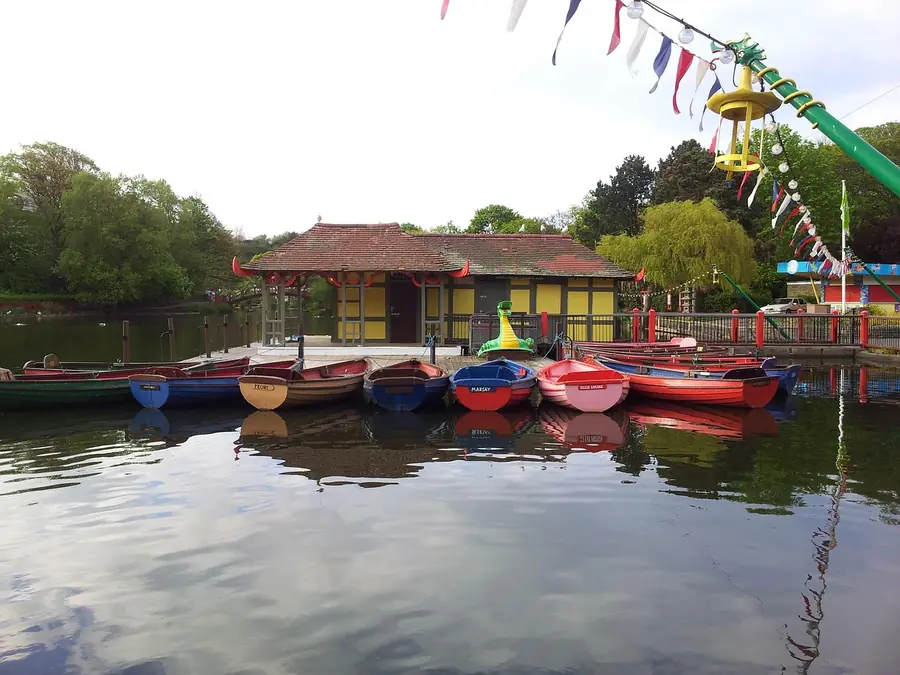
Peasholm Park is the thing people remember from North Bay, and it is the thing a surprising number of visitors to South Bay never reach. It opened in 1912 as an oriental-themed municipal park: a boating lake, a pagoda on an island, red bridges, a cascade, and planting that was exotic by the standards of an Edwardian Yorkshire resort. A century later it is still free to walk into, still slightly improbable, and still the best-kept public space in Scarborough.
It sits behind North Bay, about 1.2 kilometres from the town centre — twenty minutes on foot, a short bus ride, or the far side of a decision not to spend the whole day on Foreshore Road. The attraction page covers the facts. This is how to use the park for a morning, a half day, or the Naval Warfare afternoon that is the only show of its kind.
The ground was the medieval manor of Northstead, Crown land from the fourteenth century, open fields and allotments by 1900. In 1911 Scarborough Corporation bought Tucker’s Field from the Duchy of Lancaster. Harry W. Smith, the borough engineer who also laid out the Italian Gardens on South Cliff, set the new park in the Japanese style then fashionable at English resorts — statues from Killerby Hall, shrubs imported via a local banker living on the Riviera, a lake where the valley broadened toward the sea.
It opened in June 1912. In 1924 the Corporation extended it south-west along Peasholm Glen, a natural wooded ravine, after buying more land from the Duchy. The park is about 14 hectares. Historic England added it to the Register of Parks and Gardens at Grade II in 1999.
The holiday trade that paid for it fell away from the 1970s. The pagoda was burned by vandals in 1999 and the park closed. Heritage Lottery funding, with the borough council, paid for the pagoda to be rebuilt in fire-retardant timber, the Half-Moon Bridge to be replaced, the cascade to be repaired and the silted lake to be drained and restored. What you walk through now is that restoration, not a faded original. It is on the Historic England list as a designed landscape, which is a reason to treat it as more than a playground with boats.
The centrepiece is an artificial boating lake with a tree-covered island. A Japanese-style bridge leads over; a path climbs to a hidden garden and the pagoda, which looks out over the treetops and up the glen. The island is gated and tends to be open in the daytime in season. If the gate is locked, the view from the shore is still the park.
The lake is where the boats run and where, on set summer days, the Naval Warfare takes over. The rest of the time it is pedalos, rowing boats, ducks, and people sitting on the terraced banks. Floodlighting in season turns the island into the thing you walk around after tea.
The main circuit of the lake is level and surfaced. The main circuit of the boating lake is the level loop most visitors walk, and it is the stretch of Peasholm that works with a pushchair or a wheelchair. Everything else — the glen, the island, the cascade — climbs.
This is Peasholm’s genuine oddity, and it has run since 1927. George Horrocks, the Corporation’s entertainments manager, put model First World War warships on the lake — boats up to about twenty feet long, with a person sitting inside to steer. Electricity arrived in 1929 for the smaller craft; the large ones are still crewed. After the Second World War the fleet was rebuilt around a River Plate scenario. These days the script is a more generic battle: friends and enemy, explosions, smoke, a soundtrack, and model aircraft running down a wire.
It is ticketed. It is the only show of its kind. Families with children of about nine to thirteen are the audience it was built for, and it still lands. It also looks faintly ridiculous until the first charge goes off, at which point it is completely charming.
Behind the lake, the glen is a different place. It is a steep-sided ravine with a waymarked tree trail, rare and unusual species, and several champion trees. A survey during the restoration found a Dicksonian elm that had been thought extinct. The trail is quieter than the lake by a wide margin. On an August afternoon when the Naval Warfare banks are packed, the glen is still a wood.
It climbs. Dogs are welcome in the park; the glen is the part they enjoy most. The cemetery at the south-west end is the old boundary, not a continuation of the outing.
Give the glen half an hour if you only walk the lake. Give it an hour if trees are why you came. It is the part of Peasholm that the seafront never sees.
Pedalos and rowing boats are hired from the boat deck in season. Opening is not continuous: the council lists blocks of daily opening through the spring holidays and summer, weekends only in the shoulders, and a close from early November until Easter. Prices sit on the same page and are reviewed. A half hour on the water is the thing children remember after the pagoda.
There is a putting green and a pitch-and-putt. Mini golf has its own summer window. None of this is why you come, but it is why a family stays for three hours instead of one.
The café follows a similar seasonal pattern — daily in the main season, weekends and holidays at the ends of the year. Confirm rather than counting on a full menu in February. There is an ice-cream kiosk when the boats are running.
The bandstand sits on the water. Free Sunday band concerts have been a summer fixture; the council lists the bands year by year. Open-air concerts use the park as well. On a still evening the lake does the acoustics.
The park itself does not close. The paid bits do.
Peasholm is the start of a North Bay day, not a detour from South Bay.
The North Bay Railway starts beside the park. It is a 20-inch-gauge miniature line of 1931, about 1.4 kilometres along the cliff to Scalby Mills: ten minutes each way, views over the sand, dogs carried. At the far end are SEA LIFE Scarborough, a pub, the beach and the Cleveland Way north. The useful pattern is to ride out and walk back along the promenade or the sand — half an hour, level, sea alongside.
Alpamare UK is a few minutes up Burniston Road: indoor slides, heated outdoor pools, the wet-day half of the same outing.
North Bay beach is across the road. Wider than South Bay, quieter, more sand at high tide. On a windy day, check which bay is in the lee before you commit; the two bays guide is the geography.
Northstead Manor Gardens, next door, hold the Open Air Theatre. Concert nights change the feel of this whole corner. On those evenings Peasholm is the pre-show park; on every other day it is the destination.
Early morning for an empty circuit and the island to yourself. A weekday in May or September for the park as a park, boats if they are running, no battle crowds. A set summer afternoon if Naval Warfare is the point — arrive in time, and do not park in South Bay and hope.
Drizzle suits the glen. The lake is atmospheric in it; the boats may not be out. See Scarborough in the rain.
A gale is the glen only. The lake is exposed enough that the show cancels and the pedalos stay stacked.
Winter is trees, water, and a café that may be shut. It is still free, and it is still better than a shuttered seafront.
Free to enter. Boating, putting and Naval Warfare are charged; read the board and the council page.
Parking: Northstead upper on Ryndle Crescent is the park for this. Do not drive into South Bay first. Northstead lower is closer to the sand and smaller. On-street around the park is limited.
Getting there: seafront bus, open-top in season, or walk from town in about twenty minutes. The miniature railway is how you leave, not how you arrive, unless you started at Scalby Mills.
Time: an hour to walk the lake; two or three with a boat and the glen; half a day with Naval Warfare and the railway.
Access: lake circuit level; glen and island are not. Toilets and a café in season. The council lists disabled access among the facilities; the steep bits remain steep.
Dogs are welcome. Keep them off the water when the boats and the battles are running.
Peasholm is where Scarborough goes to be pleasant rather than to be a resort. The seafront is a few hundred metres away and a different century. Walk the lake, climb the glen if you can, and if the timetable gives you a battle, stay for it. Then take the little train north, or cross the road to the sand. That is a North Bay day, and it is the one South Bay does not know it is missing.